 by Don'tForgetDad Team
Receiving news of abnormal mammogram results can feel like the world stops spinning for a moment. But before you go any further, please hear this loud and clear: it does not automatically mean you have cancer. An abnormal result simply means the radiologist saw something that needs a closer, clearer look. That call back for more tests? It’s a very common, routine next step to be extra sure everything is okay.
That Unexpected Call About Your Mammogram
Hearing the word "abnormal" attached to your health is jarring, especially after a routine screening you thought was just an item to check off your list. It’s completely natural for your mind to leap to the worst-possible conclusion. It’s a deeply human reaction. So please, just for a moment, take a deep breath. Let's walk through what this call really means and why it’s more about being thorough than it is a reason to panic.
Here’s a good way to think about it: a screening mammogram is like taking a quick, general snapshot of a room. Sometimes, the photo comes out a little blurry in one corner, or a weird shadow makes it hard to tell exactly what an object is. You wouldn't immediately assume the worst about the room; you’d just go back and take another, sharper picture from a different angle. That’s precisely what a follow-up appointment is for—it's just a chance to get a much sharper view.
Why Your Results Might Be Flagged
More often than not, the reasons for a callback are simple and have nothing to do with cancer. Radiologists are trained to be incredibly cautious, and they will flag anything that isn't perfectly, crystal clear. Honestly, this is a sign that the system is working exactly as it should to protect you.
To help demystify some of the terms you might hear, here's a quick look at the most common reasons a mammogram gets flagged for a second look.
Common Reasons for an Abnormal Mammogram Finding
| Finding | What It Often Means | Is It Usually Cancer? |
|---|---|---|
| Dense Breast Tissue | Your breast tissue has more glandular and fibrous tissue compared to fat, which can make it harder to see everything clearly on a 2D image. | No. This is a very common and normal breast type, not a disease. |
| Cysts | These are simple, fluid-filled sacs. Think of them like tiny water balloons in the breast tissue. | No. Simple cysts are extremely common and benign (non-cancerous). |
| Calcifications | Tiny deposits of calcium in the breast tissue. They can appear as small white specks on the mammogram. | Almost always no. The vast majority are harmless and related to aging or past inflammation. |
| Unclear Image | The image might be blurry due to movement, or overlapping tissue might have created a shadow that needs clarification. | No. This is a technical issue, not a medical one. A clearer image is needed to rule anything out. |
As you can see, most of these findings are routine and benign. The follow-up tests, like a diagnostic mammogram or an ultrasound, are designed to quickly tell the difference between something harmless and something that needs more attention.
"The first thing to know? An abnormal mammogram doesn’t automatically mean breast cancer. In fact, most follow-up tests confirm that everything’s just fine. It’s a signal to investigate, not a final diagnosis."
Putting It into Perspective
It’s so easy to feel completely alone in this, but you are far from it. About 10% of screening mammograms result in a woman being called back for more testing. That’s one in every ten. But of those callbacks, only a tiny fraction—roughly 7%—actually end up being a breast cancer diagnosis. The overwhelming majority are false alarms. You can discover more insights about mammogram recall rates and their outcomes.
This waiting period is undeniably stressful. Give yourself a lot of grace and kindness right now. Imagine your daughter is worried about a school test; you’d tell her to just focus on the next question, not the final grade. Today, your only job is to schedule that follow-up appointment. Taking that one small, actionable step is all you need to focus on. You’re being a responsible and proactive advocate for your own health, and that is something to be genuinely proud of.
Decoding the Radiologist's Report
Once you’ve scheduled that follow-up, the next step is often facing the radiologist’s report. This document can feel like it’s written in a completely different language, full of medical terms that sound complicated and intimidating. But you don't need a medical degree to understand what it says. Let's gently pull back the curtain on this report and translate the key findings into plain, simple language.
Think of the report as a detailed map the radiologist creates of your breast tissue. They are carefully marking any landmarks that need a second look. Our goal here is to help you read that map, so you can feel more prepared and less overwhelmed when you speak with your doctor.
This simple decision tree shows the common path after receiving a call about your mammogram, leading from you to the call and then to the next test.
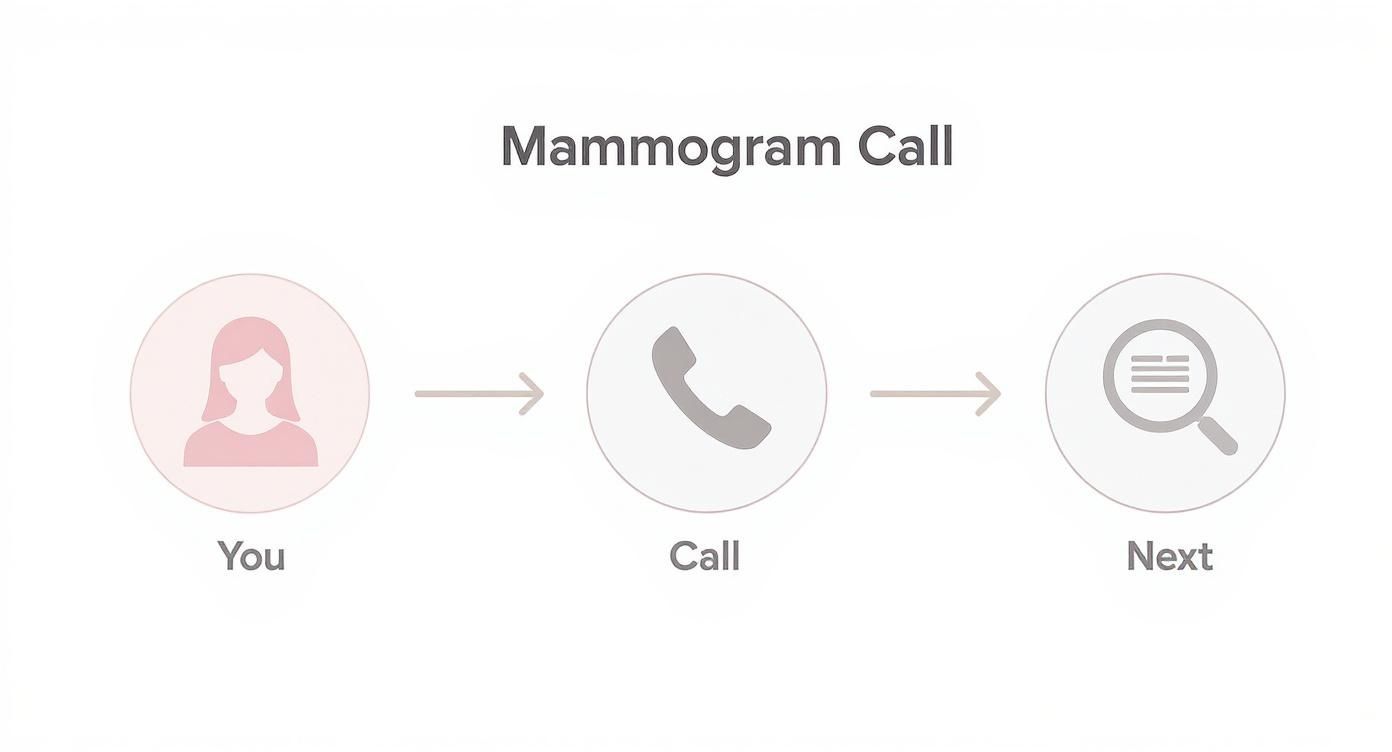
As you can see, a callback is simply a trigger for more investigation. It's a routine step to get a clearer picture.
Common Findings Explained in Simple Terms
When you look at the report, you’ll likely see a few specific terms used to describe what the radiologist saw. These are the most common ones, and they are almost always not a cause for alarm.
Calcifications: Imagine sprinkling a few tiny grains of salt onto a dark piece of paper. That’s often what calcifications look like on a mammogram. They are just tiny deposits of calcium in the breast tissue. While certain patterns can be a concern, the vast majority are completely harmless and often related to normal aging.
Mass: This word can sound scary, but it’s simply a medical term for a spot or area that has a defined shape. A mass could be a simple, fluid-filled cyst (like a tiny water balloon) or a benign solid growth called a fibroadenoma (think of a small, smooth grape). Follow-up tests like an ultrasound are excellent at figuring out exactly what type of mass it is.
Asymmetry: This just means that an area in one breast looks different from the same area in the other breast. It's often just due to normal variations in breast tissue, but radiologists are careful and will want to confirm it’s not hiding anything.
Seeing these terms on your report is the first step in a process of clarification, not a final answer.
Understanding Your BI-RADS Score
Every mammogram report includes a BI-RADS score. This is a numbering system that radiologists use to communicate their findings in a standardized way. It’s not a cancer grade; it’s a scale that tells your doctor how confident the radiologist is about the results and what the next steps should be.
Think of the BI-RADS score like a traffic light. A low number is a green light, meaning everything looks normal. A middle number is a yellow light, signaling a need for caution and a closer look. Only the highest numbers are a red light, indicating a strong suspicion that requires immediate action.
Here’s a simple breakdown of what each category means for you.
Understanding Your BI-RADS Score
This table can help you translate your score into plain language, so you know exactly what to expect.
| BI-RADS Category | What It Means | What Happens Next |
|---|---|---|
| 0 - Incomplete | "We need more information." The images weren't clear enough, or there's something that needs another look. | This is the most common reason for a callback. You'll be asked to come in for more imaging, like a diagnostic mammogram or ultrasound. |
| 1 - Negative | "Everything looks clear and normal." | You can continue with your routine annual screenings. |
| 2 - Benign | "We see something, but it's definitely not cancer." This could be a simple cyst or harmless calcifications. | You can continue with your routine annual screenings. |
| 3 - Probably Benign | "This looks almost certainly benign (over 98% chance), but we want to be extra safe and watch it for a bit." | A short-term follow-up is usually recommended, typically a repeat mammogram in six months to ensure nothing has changed. |
| 4 - Suspicious | "This finding doesn't look typical, and there is a possibility it could be cancer." This category is broad and often broken down into 4A, 4B, and 4C to show increasing levels of concern. | A biopsy is typically recommended to get a definitive answer. Remember, even in this category, many biopsies come back benign. |
| 5 - Highly Suggestive of Malignancy | "This looks very much like cancer (at least 95% chance), and a biopsy is needed to confirm it." | A biopsy is necessary to confirm the diagnosis and plan for treatment. |
Understanding this score can transform a confusing report into a clear plan. Knowing that a BI-RADS 3 means "let's watch this" instead of "it's cancer" can make a world of difference for your peace of mind.
Here’s a small, hopeful tip: write down your BI-RADS score and one question you have about it. Bringing this to your doctor's appointment can help you feel more in control and part of the team.
Navigating Your Follow-Up Appointments
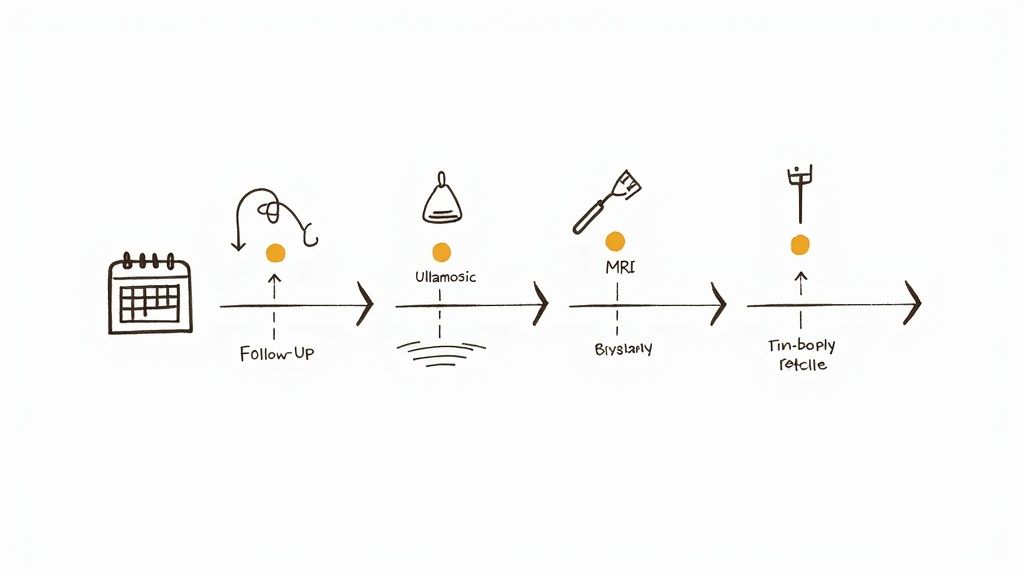
Getting that call back after a mammogram can send your mind racing. But knowing what comes next can turn that swirl of uncertainty into a clear sense of purpose. The waiting period is often the hardest part, but having a roadmap of the next steps helps you feel more grounded and in control.
Think of it like a detective story. The first mammogram found a clue. Now, your medical team is just bringing in more specialized tools to examine that clue more closely and figure out exactly what it is. Each appointment is simply a step toward getting a definitive answer—and more often than not, that answer is a reassuring one.
Let’s walk through the most common follow-up appointments together, so you know exactly what to expect and why each step is recommended.
Getting a Sharper Picture with More Imaging
The very first step after a callback is almost always more detailed imaging. This is completely standard procedure; it’s not a sign that something is definitely wrong. It’s simply the best way to get a much better look at the area that caught the radiologist's eye.
Diagnostic Mammogram: This is a lot like the screening mammogram you already had, but it’s much more focused. The technician will take more pictures of that specific area of breast tissue, often from different angles or with magnification. It’s like using the zoom lens on a camera to get a crystal-clear, close-up shot.
Breast Ultrasound: If the mammogram showed a mass or a dense area, an ultrasound is the perfect next step. This test uses sound waves—not radiation—to create a picture of the tissue. It’s especially good at one thing: telling the difference between a solid mass and a simple, fluid-filled cyst (which is almost always harmless). The whole process is painless. A technician just applies a clear gel to your skin and moves a small wand over the area.
For many women, these two tests are all that’s needed to confirm the finding was benign. After that, they can go right back to their normal screening schedule with peace of mind.
When a Closer Look Is Needed
Sometimes, even after a diagnostic mammogram and ultrasound, the picture isn't 100% clear. In those cases, your doctor might suggest another test to gather more definitive information. Remember, this is still part of the investigative process.
A Breast MRI (Magnetic Resonance Imaging) is a powerful tool that might be used if your results are complex or if you have very dense breast tissue, which can make mammograms harder to read. It uses magnets and radio waves to create incredibly detailed images of the breast.
If imaging still shows a suspicious solid area, the only way to know for sure what it is is with a biopsy. That word can sound scary, but the procedure is usually quick and minimally invasive. A doctor uses a very thin needle to take a tiny sample of tissue from the area of concern. That sample then goes to a lab to be analyzed by a pathologist. This is the gold standard for getting a final, accurate diagnosis.
A recommendation for a biopsy is not a diagnosis of cancer. It is the final step to either rule it out or confirm it, giving you the concrete answers you need to move forward.
The Watchful Waiting Approach
In some situations, particularly with a BI-RADS 3 score ("probably benign"), your doctor might suggest a "watchful waiting" approach. This means the finding has a very high probability (over 98%) of being harmless, but your doctor wants to be extra cautious.
They will typically ask you to come back for a follow-up mammogram in six months, just to make sure the area hasn't changed. This careful monitoring is the sign of a thorough and responsible healthcare team.
Keeping these appointments is crucial. Timeliness is key, as an estimated 30% of women fail to receive recommended follow-up on high-risk findings, which can undermine the whole point of screening. To read more, you can learn about global breast cancer statistics from the World Health Organization.
Navigating these appointments can feel like a lot, especially if you're helping coordinate care for a parent from a distance. If you need a hand organizing reminders or sharing updates with family, our team is here to help. Please don't hesitate to get in touch with us at Don'tForgetDad to see how we can assist.
Your hopeful tip for today is to write down one or two questions you have for your doctor before your next appointment. Bringing your questions with you is a powerful way to take an active role in your healthcare journey.
Coping with the Emotional Waiting Game

The time between getting that call about abnormal mammogram results and having clear answers can feel like an eternity. This limbo, this period of waiting, is often filled with a unique and powerful blend of anxiety that many people call “scanxiety.”
If your mind is racing with "what ifs," that is a completely normal, human reaction to the unknown. Every small ache or twinge can suddenly feel magnified. It’s like waiting for a storm to pass; you can't control the weather, but you can find a safe place to wait it out.
Whatever you are feeling right now—fear, frustration, or even a sense of total numbness—is valid. There’s no right or wrong way to feel. This section is all about finding a little shelter for your emotional well-being during this tough time.
Giving Yourself Permission to Feel
So often, we feel this immense pressure to be strong for everyone around us or to just push our worries aside. But bottling up those emotions can make the waiting game feel even harder. Acknowledging your fear is the very first step toward managing it.
For a caregiver, this period can be just as agonizing. You might feel helpless watching your mom or partner worry, completely unsure of what to say or do. It’s okay to admit you don't have the answers. Simply saying, “I know this is incredibly scary, and I’m right here with you,” can be one of the most powerful and comforting things you can do.
Gentle Strategies for Managing Scanxiety
Finding small, manageable ways to care for your mind during this time can make a world of difference. It’s not about ignoring how you feel, but about creating small pockets of peace within the uncertainty.
Here are a few gentle ideas you can try right now:
- Limit Your Online Research: It’s so tempting to fall down an internet rabbit hole, but online searches often lead to worst-case scenarios that may not even apply to your situation. Try setting a boundary for yourself—maybe allow 15 minutes to look up a specific question, then close the browser.
- Connect with One Trusted Person: You don’t need to tell everyone what’s going on. Choose one friend or family member who is a really good listener and just share how you’re feeling. Voicing your fears can honestly lessen their power over you.
- Practice Mindful Moments: You don’t need to meditate for an hour. Whenever you feel that wave of anxiety rising, just stop and take three deep, slow breaths. Focus on the feeling of the air filling your lungs and then slowly leaving. This simple act can ground you in the present moment.
"The uncertainty between tests can feel like forever, even when it’s just days. These feelings are completely valid, and acknowledging them is the most important first step toward coping."
For family members, a small act of kindness can go a long way. Imagine your mom is waiting for her biopsy results. Instead of asking "any news yet?" every day, try sending a text that says, "Thinking of you today. No need to reply, just sending a hug." This offers support without demanding an emotional response from her.
Your small, hopeful step today: Choose one activity that brings you a moment of calm—whether it's listening to a favorite song, stepping outside for some fresh air, or enjoying a warm cup of tea—and give yourself five minutes to do just that. You deserve that little bit of peace.
How Family and Friends Can Truly Help
When someone you love gets that call about abnormal mammogram results, your first instinct is to fix it, to take away their fear. But of course, you can't. It can be incredibly hard to know what to say or do, and generic offers like "let me know if you need anything" can sometimes feel hollow, putting the burden back on them.
The truth is, the most powerful support often comes from small, specific, and practical acts of kindness. It's about lightening their load in real, tangible ways, showing you’re right there with them without adding to their emotional weight. This is where you can make a genuine difference during a time that feels completely overwhelming.
Offer Specific, Practical Support
Instead of asking your loved one to come up with a to-do list for you, try to anticipate what they might truly need. During the agonizing waiting game and the flurry of follow-up appointments, their mental energy is already stretched thin. Making even small decisions can feel exhausting.
Here are a few concrete ways you can step in and help:
- Be the Note-Taker: Offer to go to appointments with the sole job of taking notes. You could say, "I'll be your second set of ears and just write everything down, so you can focus completely on listening and asking your questions."
- Prepare Questions Together: Before a doctor’s visit, sit down with them and help brainstorm a list of questions. Walking into an appointment with a plan can make it feel far less intimidating and much more productive.
- Provide Quiet Company: Sometimes, the best thing you can do is just be there. Offer to drive them to an appointment and simply sit with them in the waiting room, no conversation necessary. Your calm presence can be incredibly grounding when their world feels like it's spinning.
The goal isn't to solve the problem, but to share the emotional weight of it. A simple, 'I'm here, and we'll get through this together,' can mean the world.
Communicate with Kindness and Respect
How you communicate during this time is just as important as what you do. Your loved one is likely navigating a storm of anxiety and vulnerability. A thoughtful message can bring a wave of comfort without demanding a reply, which in itself can feel like a gift.
For example, instead of asking "Any news yet?" every day—a question that can spike their stress—try sending a text that offers pure, unconditional support. Something like:
"Thinking of you today. No need to reply, just sending a hug."
This simple message lets them know you care, respects their emotional space, and doesn't require them to manage your anxiety on top of their own. It’s a small shift that can have a huge impact.
Understand the Importance of Timely Follow-Up
As a supporter, one of the most vital roles you can play is to gently encourage prompt follow-up. The anxiety of waiting for answers is brutal, but letting appointments slide can pose a significant risk. When it comes to breast health, early detection and timely intervention are everything.
Statistics show that thanks to mammography, over 66% of breast cancers are found at localized stages, which is linked to a 5-year survival rate of about 99%. That incredible success, however, depends entirely on following through after getting that initial call. Clinical guidelines stress how essential timely follow-up is, both for confirming benign findings to ease anxiety and for ensuring the best possible outcome if something is found. You can read the full report on cancer facts and figures for 2025 to better understand these outcomes.
Tools designed to help families coordinate care can be a game-changer here. For families juggling multiple schedules or supporting a parent from a distance, a simple app can ensure that critical follow-up appointments aren't missed. The team behind Don’tForgetDad was inspired by the need to create a simple, shared system for these exact situations. You can read more about our mission to help families stay connected and on track with important health reminders.
Your hopeful takeaway is this: Your support is powerful. By offering specific help, communicating with compassion, and being a steady presence, you can transform a period of fear into a time of connection, showing your loved one they are not facing this alone.
Answering Your Most Pressing Questions
When you get that call about an abnormal mammogram, your mind can start racing. It’s completely natural to have a whirlwind of thoughts and worries. This space is for those questions—the ones that keep you up at night—answered in a clear, straightforward way to bring you a little calm and clarity.
You are not alone in asking these things. Voicing your concerns is a sign of strength and a huge part of taking charge of your health journey.
Does an Abnormal Mammogram Mean I Have Cancer?
This is the first question on everyone's mind, so let’s get right to it: an abnormal mammogram does not automatically mean you have cancer. In fact, most of the time, it doesn't. Fewer than 1 in 10 women who are called back for more tests are actually found to have cancer.
Think of an "abnormal" result as the radiologist's way of saying, "I see something that isn’t perfectly clear, and we need a closer look." It could be a harmless cyst, dense breast tissue creating a shadow, or just a fuzzy image that needs a retake.
Think of it as a flag for further investigation, not a diagnosis. The entire purpose of follow-up testing is to figure out exactly what that flag means, and the vast majority of the time, the final answer is a reassuring one.
How Long Will I Wait for Follow-Up Tests and Results?
The waiting period is often the hardest part, and the uncertainty can feel incredibly heavy. While timelines vary depending on the clinic, most facilities understand the anxiety and try to move quickly.
Typically, you can expect to be scheduled for follow-up appointments, like a diagnostic mammogram or an ultrasound, within a few days to a couple of weeks after the initial call.
- For Additional Imaging: Often, the radiologist will discuss the results from these next imaging tests (like a diagnostic mammogram or ultrasound) with you on the very same day.
- If a Biopsy Is Needed: If a biopsy is recommended, it might take a few more business days to a week to get those pathology results back.
It is always okay to ask the scheduling staff about the expected timeline when you book your appointment. Knowing what to expect can help ease some of the anxiety of being in limbo.
What Questions Should I Ask My Doctor?
Walking into your appointment with a few questions ready can give you a powerful sense of control. It helps ensure you leave with the information you need to feel confident about what’s next. It’s a great idea to write them down beforehand so you don't forget in the moment.
Here are a few questions you might consider asking:
- "Can you please explain my results in simple, everyday terms?"
- "What specific finding are you concerned about on my mammogram?"
- "What is the next test you recommend, and what will it tell us?"
- "What are the possible outcomes or findings from this next test?"
- "When can I expect to have the final results and a clear answer?"
Don’t ever feel shy about asking someone to repeat something or explain it in a different way. This is your health, and you deserve to understand everything completely.
I Had a False Alarm Before. Is This Likely to Happen Again?
It’s true that if you’ve had a false-positive result in the past, you might be slightly more likely to have another one. This is often due to underlying factors that don't change, like having dense breast tissue, which can make mammograms trickier to read.
Radiologists are trained to be extremely cautious. They would much rather investigate a harmless spot and confirm it's nothing to worry about than ever risk missing something potentially serious. While it can be frustrating to go through the process again, try to see it as a sign that your healthcare team is being incredibly thorough.
For families navigating these repeat experiences or just trying to stay organized with medical appointments, exploring resources can be a big help. You can learn more about caregiving strategies and support on our Don’tForgetDad blog, where we share insights for families just like yours.
Here is a hopeful thought to carry with you: Asking questions and seeking clarity are your greatest tools right now. Each question you ask is a step toward taking back control and moving from a place of fear to a place of empowerment.
Navigating follow-up appointments and managing the emotional wait can be challenging for the whole family. Don’tForgetDad makes it easier to coordinate care, share updates, and ensure no important appointment is ever missed. Our simple tool sends gentle reminders for medications and check-ups, keeping everyone connected and informed, so you can focus on supporting your loved one. Visit Don’tForgetDad today and see how we can bring your family a little more peace of mind.