 by Don'tForgetDad Team
Being a caregiver often feels like you're lovingly managing someone's entire life, and keeping track of medications can be one of the most stressful parts of that journey. A reliable track medication app can be a true lifesaver, acting as a warm, central hub for you, your loved one, and any other family members involved in their care.
It's about bringing a sense of calm and order to what can feel like a chaotic daily routine.
Finding Calm in the Chaos of Caregiving
Let's be honest: juggling prescriptions, doctor appointments, and your own life is a heavy lift. That constant mental checklist never seems to shut off. "Did Dad take his blood pressure pill? Does Mom need a refill on her heart medication soon?" This emotional and logistical weight is immense, and it can feel incredibly isolating, especially when you're trying to coordinate care with siblings or other helpers.
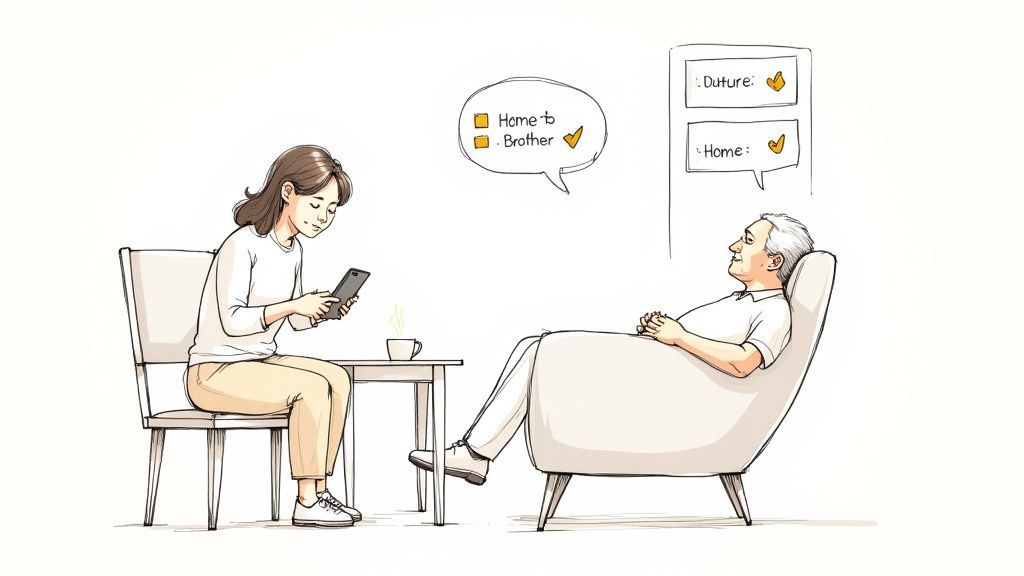
This is where a good track medication app stops being just a piece of software and becomes a true partner in your caregiving journey. Think of it as a shared family notebook that never gets lost, is always up to date, and is accessible to everyone who needs it, no matter where they are.
Bridging the Distance for Families
Consider a common scenario that so many families face: a daughter is the main caregiver for her father's multiple daily medications, while her brother lives in another state. Their communication used to be a frantic mess of texts, missed calls, and a constant game of telephone. The daughter feels the full weight of being the one on-site, and the son feels disconnected and helpless from afar.
An app with shared access changes this dynamic completely.
- Shared Responsibility: When the daughter logs their dad's morning pills, her brother gets an instant update on his phone. The burden feels lighter because it's shared.
- Immediate Peace of Mind: He doesn't have to call and interrupt her day just to ask if the meds were taken. A quick glance at the app tells him their father's care is on track.
- Centralized Communication: Crucial notes, like "Dad felt a bit dizzy after the new medication," can be logged for the whole care team to see. This creates an invaluable health record over time.
This isn't just a niche need; it's a massive trend. In 2023, the market for pill tracker apps was valued at a staggering USD 1.2 billion and continues to grow. This boom shows just how many families are actively looking for these kinds of digital tools to make caregiving more manageable.
This technology doesn't replace human connection; it strengthens it. By handling the logistics, an app frees up your mental space for what truly matters—spending quality time with your loved one, not just managing their pillbox.
For more real-world stories and practical advice on navigating the caregiving journey, feel free to explore other articles on our blog. Taking this one small step can restore a sense of control and bring some much-needed relief to your daily routine.
Choosing the Right App for Your Family
https://www.youtube.com/embed/0LMXaQ30HH4
Trying to find the right track medication app can feel a lot like standing in a crowded pharmacy aisle. With so many options calling for your attention, they all start to blur together. The trick is to look past the flashy bells and whistles and focus on what will genuinely make your family’s life easier, not more complicated.
You're looking for a tool that feels like a helping hand, not another frustrating piece of technology to learn. For most families, that starts with simplicity. Picture your parent trying to use it—is the text big and easy to read? Are the buttons clear? The best app is the one that doesn't add to the stress.
What Truly Matters for Caregivers
When you start comparing options, a few features quickly become essential for anyone trying to build a reliable caregiving team.
Let's say your sister helps out with Dad on the weekends. An app with Family Syncing is an absolute game-changer. It means she can see the entire medication history and log the doses she gives, and you'll see that update instantly. No more "did you or didn't you?" phone calls.
This kind of shared access creates a seamless circle of care.
Of course, your peace of mind is paramount. You're handling incredibly sensitive health information, so look for apps that are clear and honest about their privacy policies. Your family's data deserves the same level of protection you give your loved one.
Essential Features for a Caregiver-Friendly Medication App
To help you cut through the noise, here is a quick comparison of the features that are most critical when managing a loved one's care.
| Feature | Why It Matters for Caregivers | What to Look For |
|---|---|---|
| Family Syncing | Lets siblings, spouses, or professional aides see real-time updates and share responsibility without endless texts and calls. | Look for terms like "Share with Caregivers," "Invite Family," or "Team Collaboration." |
| Clear Interface | Ensures the app is genuinely easy for everyone to use, especially seniors who might not be tech-savvy. | Check for large fonts, simple icons, and an uncluttered screen. It shouldn't feel overwhelming. |
| Refill Reminders | Avoids that last-minute panic when you realize a crucial prescription is almost out, giving you plenty of time to call the pharmacy. | A feature where you can enter the pill count and get an alert when the supply is running low. |
| Symptom Tracking | Creates a powerful log to share with doctors, helping connect medication changes to how your loved one is actually feeling. | A simple notes or journal section to quickly log things like "felt dizzy after lunch" or "had more energy today." |
This table covers the core functions that every caregiver should look for.
Beyond the Basics: Finding Your Perfect Fit
While the table hits the essentials, every family’s situation is a little different. Maybe your dad is on a really complex schedule, with dosages that change all the time. If that’s the case, an app with flexible scheduling and a crystal-clear historical log is going to be your top priority.
For others, the biggest hurdle is coordinating care from a distance. If you're managing everything for a parent in another city, the most important feature might be rock-solid, immediate missed-dose alerts that ping you and anyone else on the care team.
Digging into a few different options will help you see what clicks. Our guide to the best medication reminder app for Android is a great place to continue your search.
The goal isn't just to find an app that reminds you about pills. It's to find one that brings your family closer, reduces your daily anxiety, and gives everyone involved a shared sense of confidence and peace of mind.
Ultimately, the right app should feel like it was built just for your family. Take a minute to think about your biggest daily struggle. Is it communication? Forgetting refills? The best tool will be the one that solves that specific problem, making your caregiving journey just a little bit smoother.
Setting Up Your Loved One’s Profile
This is where the app starts to feel less like a piece of technology and more like a dependable partner. Getting your loved one’s profile set up is your first real step toward that shared peace of mind. Let’s walk through it together—not as another chore, but as the moment you start building a digital safety net for your family.
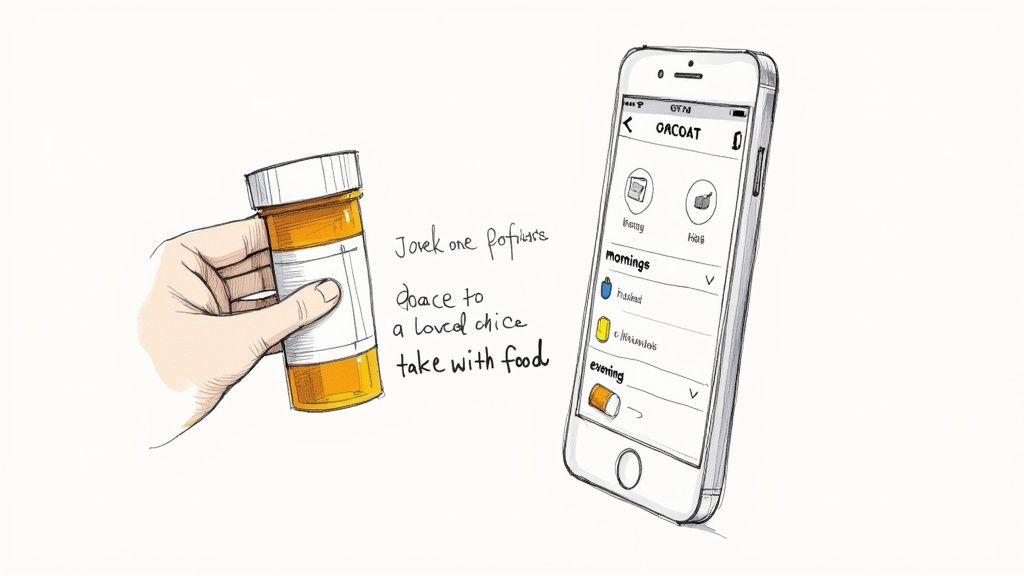
I know the initial setup can feel like just one more thing on an already overflowing plate. But trust me, think of this as a one-time investment. The calm and confidence it brings you every day afterward is more than worth it.
Making It Simple and Stress-Free
First things first: entering all the medications. Some of those prescription names look like a jumble of letters, and typing them out is just asking for a typo. Instead of squinting at the bottle, look for a feature that lets you use your phone’s camera to scan the prescription label. It’s a small detail that makes a huge difference, ensuring you get everything right from the start.
Managing complex medication schedules is incredibly common. In the United States, about 46% of the population uses at least one prescription drug monthly, and that figure climbs much higher for older adults. With so many juggling pills, it’s not surprising that up to 50% of chronic disease prescriptions aren't taken as directed. This is exactly the problem these apps are built to solve.
From Morning Pills to As-Needed Relief
Let's walk through a real-world example. Say you're setting up a profile for your mom. Her medication routine might look something like this:
- Morning Meds: A blood pressure pill and a vitamin D supplement, both taken daily at 8 AM with breakfast.
- Evening Meds: A cholesterol medication scheduled for 9 PM, just before she goes to sleep.
- As-Needed Pain Relief: A prescription for arthritis pain, which she only takes during a flare-up.
A good app lets you create a separate entry for each of these, mirroring her actual daily life. You can put the 8 AM and 9 PM pills on a recurring daily schedule. For the pain reliever, you’ll want to add it as an "as-needed" or "PRN" medication. This way, you can log a dose whenever she takes it, but it won’t trigger a fixed daily alarm.
The real magic happens when you add those small, human details. Adding a simple note like "take with a full glass of water" or "must be taken with food" transforms a generic reminder into personalized care.
These are the critical little instructions you'd normally have to repeat to a sibling or a visiting nurse. By putting them right in the app, you ensure that anyone helping out has the exact same information. It creates a consistent, safe routine for your mom, no matter who is with her that day.
It’s all about capturing the heart of her care. The goal is to build a profile so thorough and clear that any family member could step in and know exactly what to do.
So take a few deep breaths. This setup process is a hopeful step forward. You're not just plugging data into a phone; you're building a reliable system that will support both you and the person you love.
Bringing Your Family on Board with Shared Access
Caregiving isn't a solo mission—or at least, it shouldn't be. It truly takes a village, yet so often, one person ends up carrying most of the weight. This is where a track medication app does more than just send reminders; it can become the central hub for your entire support system, sharing the responsibility and the peace of mind.
You don’t have to juggle every detail alone. Think about bringing your siblings, a trusted neighbor, or even a professional home health aide into the loop within the app. Taking this one step can completely change your daily routine, shifting it from a state of constant worry to one of shared confidence.
How a Shared App Lightens the Load
Let's say you're stuck in traffic, running late to give your mom her evening medication. Instead of that familiar wave of panic, you can just send a quick message to your brother who lives nearby. He can pop over, give her the pill, and mark it as "taken" in the app. Instantly, you see the update and can let out a sigh of relief.
This shared visibility creates a powerful safety net. It’s not about micromanaging each other; it’s about having each other's backs. The app works behind the scenes as a quiet coordinator, making sure care happens seamlessly, even when life throws you a curveball.
Here are a few of the immediate benefits you’ll notice:
- Fewer "Did you...?" texts: Instead of texting you multiple times a day, family members can just check the app for the latest update.
- One clear source of truth: Everyone sees the exact same medication schedule and history, which cuts down on confusion and miscommunication.
- A shared sense of ownership: When other people can see the daily tasks involved, they often feel more connected and are more likely to jump in and help.
Connecting Your Care Team, Near and Far
Consider a family dynamic so many of us know. Sarah lives just a few miles from her dad and manages his daily care, especially his complex medication schedule. Her brother, Mark, lives across the country. He’s wrestling with that classic mix of guilt and helplessness, wanting to help but not knowing how.
By simply inviting Mark to join the app, their entire family dynamic can shift for the better.
No, Mark can't be there to physically hand his dad a pill. But he can open the app from his office and see that Sarah logged the morning medications right on time. That simple, two-second check-in eases his anxiety and makes him feel like he’s part of the team. He can even leave little encouraging notes in the app, offering emotional support that closes the physical distance between them.
This is about so much more than just tracking pills. It's about building connection and turning a logistical chore into an act of shared love and responsibility. The app becomes the digital kitchen table where everyone on the care team can gather.
With a tool like Don’tForgetDad, you can easily send a unique join code to anyone you want to bring onto your team. It’s a small, simple action that can make a massive difference. You aren't just adding another user; you're inviting someone to share the journey with you, making the path a little easier for everyone.
Using Reminders and Reports Effectively
Every caregiver knows that nagging feeling in the back of their mind: "Did Mom remember her afternoon pill?" It's a constant, low-level hum of anxiety that can disrupt even the calmest day. A good track medication app is designed to quiet that noise, turning your phone into a reliable safety net with reminders and reports built for real-life caregiving.
This is about more than just setting a single, loud alarm that’s easy to swipe away and forget. It’s about creating a smart, gentle system of nudges that keeps care on track, even when life gets hectic. You can tailor alerts to be as soft as a little chime or as persistent as a recurring notification that won’t quit until the dose is logged as taken.
Creating a Safety Net with Smart Alerts
For any care team, the single most powerful tool is the missed-dose alert. Picture this: you're stuck in a meeting and can't step away, but you get a push notification that your dad's crucial heart medication is now overdue. With a shared app, that same alert can simultaneously pop up on your sister's phone or ping a trusted neighbor.
This immediately creates a collaborative response system. If you're tied up, someone else can step in to call Dad or swing by to check on him. It’s a game-changer, shifting the weight of responsibility from one person’s shoulders to a connected, responsive team.
This simple workflow shows how a care team can work together to stay in the loop.
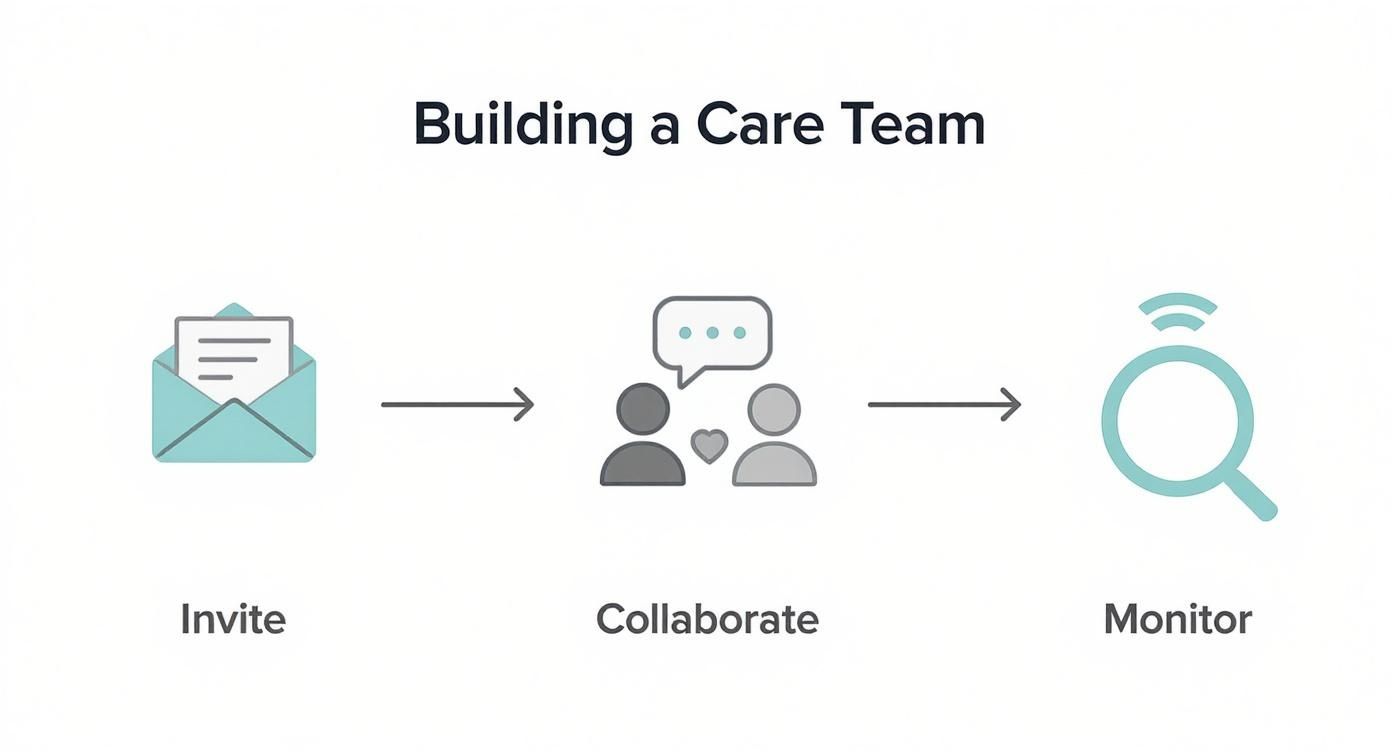
This process—inviting others, collaborating on tasks, and monitoring progress together—ensures everyone is on the same page. It turns individual effort into a shared, supportive system.
Turning Data into Better Doctor Visits
Getting ready for a doctor's appointment can feel like cramming for an exam. You’re trying to remember every little detail from the past few months. Did that new medication cause any side effects? How many times did Dad need to use his as-needed pain reliever last month?
A track medication app becomes your perfect memory. No more guesswork.
Most quality apps include a reporting feature that generates a clean, easy-to-read log of your loved one's entire medication history. With just a couple of taps, you can pull up a comprehensive summary showing:
- On-time doses: A clear, visual record of their routine.
- Missed or late doses: This is critical information that can explain why a particular treatment isn't working as well as expected.
- Symptom notes: Your own observations—like "felt dizzy after the morning pill"—logged right alongside the medication data for context.
Walking into an appointment with this report in hand is incredibly empowering. It changes the conversation from vague recollections to a helpful discussion about what's genuinely working for your loved one.
This level of detail helps doctors make better-informed decisions, and it helps you advocate more effectively for the best care. It's no wonder the medication management app market is projected to be worth $2.5 billion by 2025, driven by families who need these exact tools for more personalized, hands-on care.
As you start using these features, always be mindful that the health data you're collecting is sensitive. You can learn more about how we work to protect your family's information by reviewing our privacy practices.
If you're just getting started, try this: set up a single missed-dose alert for one critical medication. Taking that one small step can provide an immediate and immense sense of security, knowing your care team is there to catch anything that might slip through the cracks.
Your Top Questions, Answered
Jumping into a new app, especially when it’s tied to your loved one’s health, is bound to bring up a few questions. That’s perfectly normal. We’ve heard these same concerns from countless families, so let’s talk through them honestly to get you feeling comfortable and confident.
After all, the whole point of a track medication app is to bring you peace of mind, not give you something new to worry about.
Is My Loved One's Health Information Safe?
This is usually the first thing people ask, and for good reason. Your family’s privacy is incredibly important. Any reputable app will treat your health data with the same seriousness as your banking information, using strong encryption to protect it.
Before you download anything, take a minute to find the app's privacy policy. It should be easy to find and understand. If it’s buried or full of confusing language, that’s a red flag.
What If My Parent Isn't Comfortable with Technology?
This is a big one. Many older adults aren't thrilled about learning a new app, and that's okay. The beauty of these tools is that they don’t have to.
The most effective setup is often when one primary caregiver manages everything from their own phone. You set the schedules, you log the doses, you get the alerts. For your loved one, nothing changes about their daily routine. The app is your helpful tool for staying organized behind the scenes.
Can These Apps Remind Me to Order Refills?
Absolutely. This feature is a game-changer for preventing those last-minute panics when you realize a prescription is empty. It's a huge source of stress for caregivers.
Most quality apps let you enter the total pill count when you start a new bottle. As you log each dose, the app automatically subtracts from the total. When the supply runs low, you’ll get a notification, giving you plenty of time to call the pharmacy without the rush.
How Can I Share Information with Our Doctor?
This is where a track medication app really proves its worth. Think about your last doctor’s visit. Did you struggle to remember if a dose was missed two Tuesdays ago? It’s nearly impossible to recall everything accurately.
An app’s reporting feature transforms your caregiving observations into clear, helpful data. You can easily generate a log showing every dose that was taken on time, late, or missed, turning a stressful conversation into a productive, fact-based discussion about your loved one’s care.
Instead of relying on a foggy memory, you can just pull up the log on your phone or even email a report to the doctor's office beforehand. It helps you become a more prepared and effective advocate for their health.
Ready to bring this level of calm and coordination to your own family? Don’tForgetDad was built by caregivers, for caregivers, to solve these exact challenges. Get started today and create a circle of care that brings everyone peace of mind. Learn more at https://dontforgetdad.com.